
Holy Transfiguration Mirozhsky Monastery in Pskov
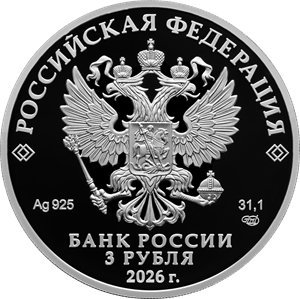
Obverse
a relief image of the National Coat of Arms of the Russian Federation, above it along the rim the inscription in a semicircle ‘РОССИЙСКАЯ ФЕДЕРАЦИЯ’ (RUSSIAN FEDERATION) framed with paired diamonds on both sides, under the coat of arms on the left the chemical symbol and fineness of the metal and on the right the fine metal content and the mint mark, at the bottom centre in three lines the inscription ‘БАНК РОССИИ’ (BANK OF RUSSIA), the coin denomination ‘3 РУБЛЯ’ (3 RUBLES), and the year of issue ‘2026 г.’ (2026).
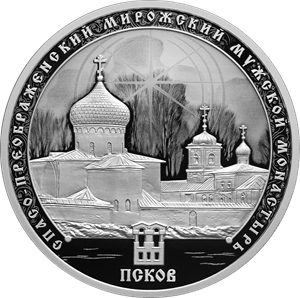
Reverse
the relief image of the Holy Transfiguration Mirozhsky Monastery against the background of the images of trees and water reflections, laser treated for matte finishing, and the relief inscriptions ‘СПАСО-ПРЕОБРАЖЕНСКИЙ МИРОЖСКИЙ МУЖСКОЙ МОНАСТЫРЬ’ (HOLY TRANSFIGURATION MIROZHSKY MONASTERY) around the circumference against the background of an ornament, laser treated for matte finishing, and ‘ПСКОВ’ (PSKOV) at the bottom.
Authors
Designers: E.V. Kramskaya (obverse), A.A. Brynza (reverse).
Sculptors: A.A. Dolgopolova (obverse), A.V. Gnidin (reverse).
Mint: Saint Petersburg Mint (СПМД).
Edge: 300 corrugations.
Discover more
The Holy Transfiguration Mirozhsky Monastery in Pskov – one of the most ancient religious houses in Russia – is located on the left bank of the Velikaya River, at the place where it is joined by the small Mirozhka River. The name of the latter derives from the word ‘mrezhi’ meaning ‘nets’, as the monastery stood next to neighbour fishing grounds.
The date and circumstances of the monastery’s founding are unknown. In the second quarter of the 12th century, a stone church dedicated to the Transfiguration of Christ was built within its walls at the behest of Nifont, Archbishop of Novgorod. The church has survived to this day in a somewhat altered form. To decorate its interior, the Archbishop of Novgorod invited a team of Greek artists, who adorned its walls with frescoes. The church’s murals are remarkable for their superb craftsmanship, vivid and rich colours, as well as rigorous and informed classical iconography.
The monastery survived many wars and sieges. Situated outside Pskov’s fortress walls, it was the first to bear the brunt of enemy attacks. Despite all these calamities, the monastery’s main church – the Cathedral of the Transfiguration of Christ – has retained both its walls and its frescoes. Today, this ensemble of monumental painting is unrivalled in Russia in both the proportion of murals that have survived (at least 80%) and their state of preservation.
The monastery was a centre of spiritual enlightenment and a guardian of the traditions of ecclesiastic art and literary culture. In the Middle Ages, the monastery had a rich library and an icon-painting workshop. Scribes copied religious texts here and the Pskov Chronicle was maintained. It was here that the epic tale ‘The Lay of Igor’s Campaign’ was copied and preserved for posterity.
Sources: https://museumpskov.ru, https://www.culture.ru.