
Sculptor Stepan Erzya, Timed to the 150th Anniversary of his Birth
Obverse
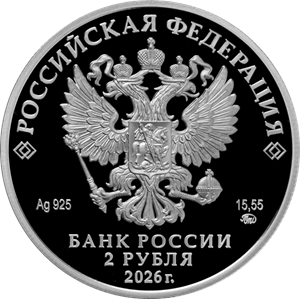
a relief image of the National Coat of Arms of the Russian Federation, above it along the rim the inscription in a semicircle ‘РОССИЙСКАЯ ФЕДЕРАЦИЯ’ (RUSSIAN FEDERATION) framed with paired diamonds on both sides, under the coat of arms on the left the chemical symbol and fineness of the metal and on the right the fine metal content and the mint mark, at the bottom centre in three lines the inscription ‘БАНК РОССИИ’ (BANK OF RUSSIA), the coin denomination ‘2 РУБЛЯ’ (2 RUBLES), and the year of issue ‘2026 г.’ (2026).
Reverse
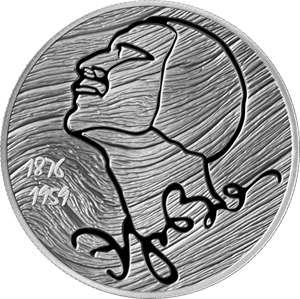
a relief field in the form of a tree cross-section with an outline self-portrait of Stepan Erzya on it, combined with his facsimile signature, and the years of his birth and death ‘1876’ and ‘1959’ in relief in two lines on the left.
Authors
Designers: E.V. Kramskaya (obverse), A.V. Gnidin (reverse).
Sculptors: A.A. Dolgopolova (obverse), A.V. Gnidin (reverse).
Mint: Moscow Mint (ММД).
Edge: 195 corrugations.
Discover more
Stepan Erzya (the real surname is Nefedov; 1876–1959) was a prominent sculptor and representative of the Art Nouveau style. His pseudonym demonstrates his relation to the Erzya ethnic group of the Mordvin peoples.
The main themes of his artworks were people, their individualities, state of mind, emotions, feelings, and mood. The sculptor was attracted by charismatic and strong personalities, passionate characters, and heroic persons, whom he embodied in female, mythological, historical, and national images (Rest, Portrait of a Mordvin Woman, Eve, Moses, Calypso, An Argentinian Lady, and many others).
Erzya’s work ‘The Last Night of a Convict Before the Execution’ became his first notable success. The sculpture was awarded first prize at the International Exhibition in Venice in 1909. Visitors of the exhibition were so impressed by the sculpture that the little-known sculptor came to be called the ‘Russian Rodin’ and the ‘Village Michelangelo’. In France, his works were purchased by both large museums and private collectors. Exhibitions in Milan, Nice, and Munich were a great success.
In addition to his favourite marble, Erzya experimented with cement, reinforced concrete, and metal. Inspired by the carvings of Mordvin craftsmen, he also did wood sculptures. After the October Revolution of 1917, Erzya began to work as a propaganda artist, creating monuments to the revolution, freedom, and workmen, which was in line with the Soviet Monumental Propaganda Plan.
After leaving for Argentina, Erzya began carving sculptures from exotic woods, namely quebracho and algarrobo. The extra hard wood required a lengthy processing, but the effort was rewarded with the wood’s original texture and beautiful shades of colour ranging from almost white to reddish-brown. In Argentina, Erzya created a vast number of artworks, some of which were acquired by museums and private collectors around the world. Argentinian newspapers published articles about the famous Russian sculptor, calling him ‘the conqueror of quebracho’.
After Erzya’s return to the USSR, the government provided him with a studio in Moscow where he organised a permanent exhibition of his works. In 1956, the sculptor was awarded the Order of the Red Banner of Labour.
Sources: https://www.culture.ru, https://erzia-museum.ru, https://екатеринбург.рф