
Mikhail Speransky
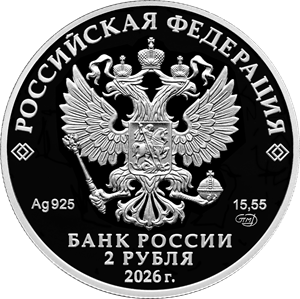
Obverse
a relief image of the National Coat of Arms of the Russian Federation, above it along the rim the inscription in a semicircle ‘РОССИЙСКАЯ ФЕДЕРАЦИЯ’ (RUSSIAN FEDERATION) framed with paired diamonds on both sides, under the coat of arms on the left the chemical symbol and fineness of the metal and on the right the fine metal content and the mint mark, at the bottom centre in three lines the inscription ‘БАНК РОССИИ’ (BANK OF RUSSIA), the coin denomination ‘2 РУБЛЯ’ (2 RUBLES), and the year of issue ‘2026 г.’ (2026).
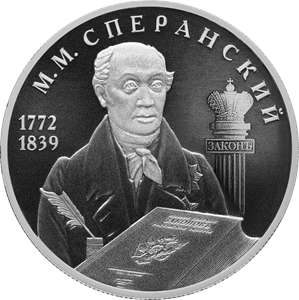
Reverse
the relief images of Mikhail Speransky’s portrait, a book, and an inkwell with a feather against the background of an image of the Pillar of the Law, laser treated for matte finishing; and the relief inscriptions ‘М.М. СПЕРАНСКИЙ’ (M. SPERANSKY) around the upper circumference as well as ‘1772’ and ‘1839’ in two lines on the left.
Authors
Designers: E.V. Kramskaya (obverse), A.V. Baklanov, National Artist of Russia (reverse).
Sculptors: A.A. Dolgopolova (obverse), A.N. Bessonov (reverse).
Mint: Saint Petersburg Mint (СПМД).
Edge: 195 corrugations.
Discover more
Mikhail Mikhailovich Speransky (1772–1839) was a Russian statesman, reformer, and the founder of Russian legal science.
Speransky went down in history as one of Russia’s leading statesmen of the first half of the 19th century. Contemporaries and historians unanimously recognised his combination of broad vision, a sharp intellect, tremendous diligence, and outstanding organisational skills. He was often referred to as ‘the Pushkin of Russian bureaucracy’ and ‘the luminary of the Russian administration’, though his rare talents and reformist initiatives remained largely unrealised. In his writings, he consistently promoted the benefits of the separation of powers and civil rights. However, he realised that the conditions for such radical change had not yet been created in Russia. The laws he drafted were only a prelude to further reforms.
Under Alexander I, Speransky focused on restructuring the highest levels of government, which, in his opinion, should be based on the principle of separation of legislature (the Duma), the judiciary (the Senate), and the executive (the ministries). At the apex of the system was to be the State Council, composed of the empire’s highest officials and serving as a link between the emperor and the branches of government. According to Speransky, voting rights were to be granted to the nobility, merchants, and state peasants.
During the reign of Nicholas I, the key achievement of Speransky was the large-scale systematisation of Russian legislation. Having worked in various positions, Speransky saw for himself the utter chaos caused by inconsistent laws, decrees, and resolutions. In 1826, Speransky began the codification of Russian legislation. On 19 January 1833, Speransky presented to the emperor the results of seven years of his intense efforts, i.e. 45 volumes of the Complete Collection of the Laws of the Russian Empire and 15 volumes of the Digest of the Laws. In recognition of this work, Nicholas I removed his own sash bearing the insignia of the Order of St Andrew the Apostle the First-Called and placed it on Speransky.
In the second half of the 1830s, Speransky devoted much of his time to the establishment of the Russian school of law. In 1835, with his active involvement, the Imperial School of Jurisprudence was founded; it went on to become one of the most prestigious educational institutions in pre-revolutionary Russia.
Source: https://history.ru.